Behind the scenes: Signify’s journey toward transparent EPDs
Signify, one of the world's leading lighting companies, has always aimed at integrating sustainability into its business strategy and portfolio design. From innovations in LED to products advancing the circular economy, their move toward making Environmental Product Declarations (EPDs) with EPD Hub was a crucial step in measuring environmental impacts across various lighting products.
We sat down with Maria Chiara Franchi, LCA & EPD Global Project Manager at Signify, to talk about how Signify began its Life Cycle Assessment (LCA) and EPD journey, how it leads the climate transition of the industry with transparency, and how the company leverages data for design development and success.

What market need or customer-specific request pushed Signify to prioritize EPDs over simpler carbon footprint reporting?
I would say that we see a growing need to understand more than just the CO₂ footprint of our company or products. EPDs address this by quantifying impacts over the entire lifecycle, not just operational carbon. Besides, EPDs follow standardized, science‑based methodologies and are independently verified. The additional indicators provided by EPDs are becoming increasingly important, especially in critical areas where water scarcity or land use play a significant role. Overall, EPDs offer a more comprehensive picture and serve the purpose of providing 360-degree transparency.
What advantages do you gain from having EPDs besides serving market demand?
Thanks to EPDs, we can identify emissions in Signify supply chain, manufacturing activities and downstream activities, and use this knowledge to improve our processes, increase the use of sustainable materials and move towards more circular design of our products.
How do regulations, like EU construction mandates or ISO 14025 updates, shape your EPD strategy?
Addressing these can be both a challenge and an advantage. It challenges us to review the way we generate EPDs: whether they are based on good-quality data, whether the reported data is complete, and whether the right methodologies are used. However, it can also be an advantage, as it provides a standardized and structured guide for how we generate EPDs and helps ensure compliance with local or international environmental regulations.
Before developing in-house EPD capabilities, did you outsource LCA work? If so, how did that impact the company? What was your experience?
Yes, we did outsource a few EPDs, but it was a costly and long process. For all these reasons combined, we decided to build a third-party verified EPD solution with in-house capabilities, knowing it would be a significant effort but also that we could build this knowledge to our advantage.
With a portfolio as vast as Signify's, which includes custom luminaires and global supply chains, what gaps in supplier data made early environmental assessments difficult to manage?
Data collection is the hardest step, especially when you have several suppliers, as we do. Some suppliers are very small and did not have the data we required readily available. Others were reluctant to share it, and with some we even had difficulties due to language barriers. By working together with our supplier base, we overcame these issues one by one and built a strong network.
What influenced your decision to choose EPD Hub?
The ability to extract results directly from One Click LCA made our decision easier. It looked like the coupling of the tool and the verifiers was an optimal choice to maximize efficiency.
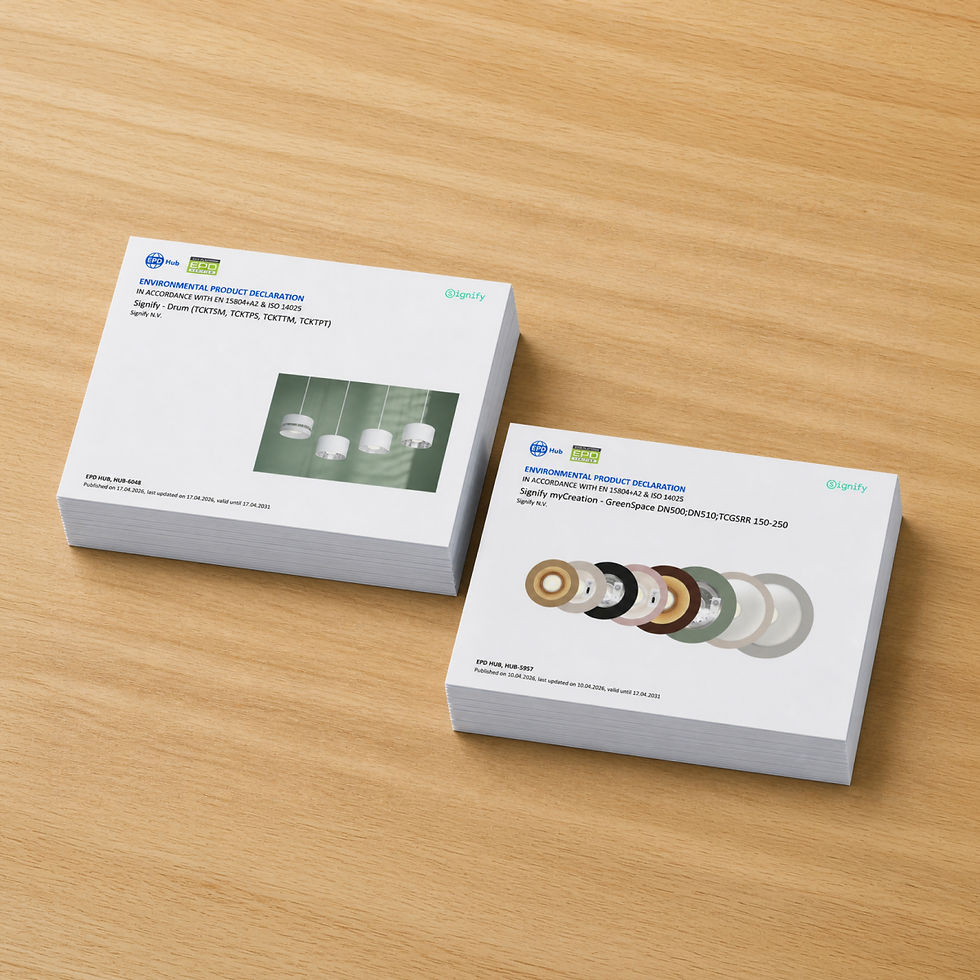
How has the EPD Hub onboarding process prepared your team to manage your company's portfolio?
It provides an understanding of the concrete workflow between Signify and EPD Hub, and this helps significantly speed up the processing time for all products in our portfolio.
How are EPD outputs benefiting marketing or even sales?
With EPDs provided for each product, it underlines Signify’s commitment to transparency in its emissions. This transparency increases credibility and trust between us and our customers, making them more confident in working with us.
With more and more customers are looking for sustainability credentials when choosing a partner, this becomes a competitive advantage for Signify.
What surprised you the most about EPDs, such as upstream raw material hotspots or end-of-life potentials in circular lighting loops?
The data we produced thanks to EPDs provides extremely useful insights for us. We can finally identify where to improve (hotspots) in terms of materials, technologies, assembly lines, and more. We are using this data to transition to an even more sustainable manufacturer.
How are EPDs helping you work with suppliers on data quality, especially CBAM-affected imports?
EPDs help us communicate how important it is to obtain reliable, as close to realistic data as possible; to accurately calculate how much carbon emissions are created during production, which is crucial for CBAM when determining the carbon price for our company.
Looking ahead, how will EPDs change your way of participating in tenders?
Public procurement is already widely using EPDs as the preferred sustainability requirement for their tenders. Also private procurement is using EPD in the RfI (request for information) and RfP (request for proposal) steps in their bidding process. EPDs enable our customers to make evidence-based decisions about sustainability lighting products.
If recommending EPD Hub to peers, what is the one game-changer they would thank you for?
The ability to collaborate and use a tool that provides automation across many steps of generating verified EPDs. Uploading models from One Click LCA into EPD Hub is done in the most effective way possible, without having to do too much manual work to process many products at the same time.


